
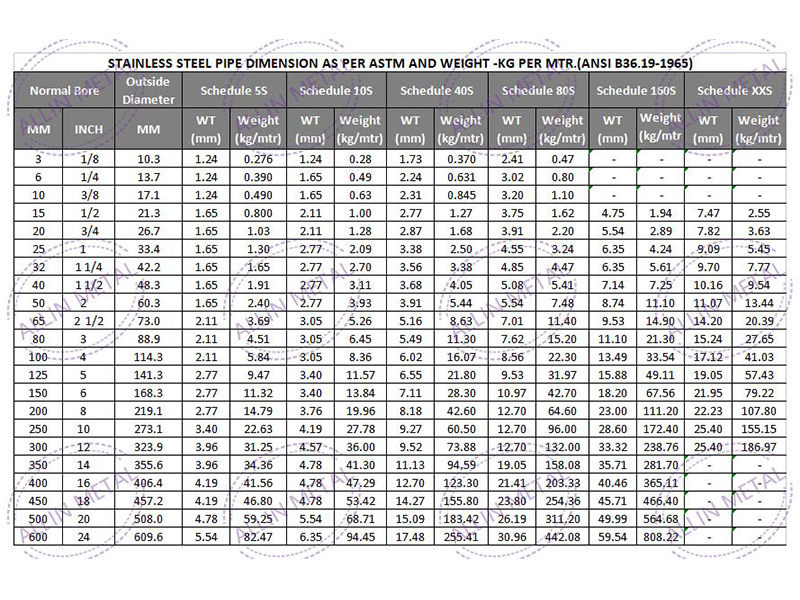
The global piping and construction industry continues to rely on unified, precision-driven dimensional standards to guarantee structural integrity, cross-system compatibility, and cost efficiency across industrial, commercial, and infrastructure projects. Among the most widely adopted global benchmarks, the ASTM stainless steel pipe specification aligned with ANSI B36.19-1965 remains the gold standard for stainless steel pipe outside diameter, wall thickness, and per-meter weight calculation, serving as a universal reference for engineers, fabricators, procurement teams, and metal suppliers worldwide.
As industrial piping systems grow increasingly complex, accurate diameter conversion between metric (millimeter) nominal bore and imperial (inch) sizing is critical to eliminate installation errors, streamline international supply chains, and ensure consistent performance of stainless steel tubing across petroleum, chemical processing, water treatment, pharmaceutical, food & beverage, and architectural applications.
Core Standard Specifications & Dimensional Conversion Framework
Per the authoritative ANSI B36.19-1965 and corresponding ASTM industrial codes, stainless steel pipes are categorized by Normal Bore (Nominal Size), offered in both metric (mm) and imperial (inch) designations. The standard covers nominal bore sizes ranging from a compact 3 mm (1/8 inch) up to large industrial 600 mm (24 inch) outside diameter configurations.
Key standardized conversion and sizing highlights include:
– Nominal Bore & OD Consistency: Each nominal pipe size features a fixed industry-standard outside diameter, for instance: 15 mm (1/2 inch) pipe has a uniform 21.3 mm outer diameter, while 100 mm (4 inch) pipe maintains a standard 114.3 mm outer diameter globally. This fixed OD design enables universal interchangeability of flanges, fittings, valves and connectors regardless of schedule rating.
– Schedule-Based Wall Thickness Grading: Wall thickness is classified by standardized Schedule numbers: 5S, 10S, 40S, 80S, 160S, and XXS. Higher schedule numbers denote increased wall thickness, enhanced pressure-bearing capacity and heavier unit weight per meter.
– Accurate Unit Weight Benchmarking: The standard provides precise pre-calculated weight data (kg per meter) for every size and schedule, empowering teams to complete structural load analysis, material quantity estimation, logistics planning, and project budget calculation with unmatched accuracy.
Industry Impact & Practical Engineering Value
Standardized diameter conversion and dimensional norms deliver tangible, long-term benefits to the global stainless steel pipe ecosystem:
- Seamless Metric-Imperial Interoperability:Engineers and manufacturers can effortlessly convert between millimeter nominal bore, inch nominal size, and actual outer diameter, removing cross-regional design and specification barriers for international projects.
- Reliable Pressure & Corrosion Resistance: Thicker schedule grades (Schedule 160S, XXS) are purpose-built for high-pressure, high-temperature, and highly corrosive working environments, extending pipeline service lifespan and reducing long-term maintenance costs.
- Optimized Procurement & Quality Control:The unified ASTM/ANSI specification creates a universal quality baseline, simplifying global sourcing, reducing production deviations, and ensuring delivered products meet consistent international quality benchmarks.
- Cost & Material Efficiency: Precise per-meter weight reference data eliminates material waste, allows for precise weight-based pricing, and improves overall project cost predictability.
Industry Outlook
With the ongoing global push for sustainable infrastructure, high-purity process piping, and long-life corrosion-resistant engineering solutions, demand for standardized stainless steel pipe specifications continues its steady upward trajectory. The ANSI B36.19-1965 ASTM standard remains irreplaceable as a foundational reference, unifying dimensional language across North America, Europe, Asia, and all major global manufacturing and construction markets.
Industry experts note that as engineering projects demand ever tighter tolerances and higher material performance, adherence to these established stainless steel diameter conversion, sizing, and weight standards will remain essential to drive project safety, compliance, operational reliability, and cross-border industry collaboration for decades to come.