
As high-corrosion and high-strength industrial scenarios continue to expand globally, 2205 duplex stainless steel has gained growing popularity across multiple industries. Boasting superior mechanical properties and outstanding corrosion resistance, this material has become a preferred choice to replace traditional austenitic stainless steel and ordinary carbon steel, with its market demand rising steadily in recent years.
Core Performance Advantages:
2205 is the most widely used duplex stainless steel grade, featuring a dual microstructure of ferrite and austenite, which combines the strengths of two types of stainless steel.
In terms of mechanical performance, its yield strength is nearly twice that of conventional 304 and 316 stainless steel. It features high tensile strength, good toughness and fatigue resistance, enabling structural components to achieve lighter weight while meeting load requirements, and effectively reducing overall project costs.
When it comes to corrosion resistance, 2205 performs remarkably well against chloride ion corrosion, pitting corrosion, crevice corrosion and stress corrosion cracking. Its anti-rust and anti-erosion capability far outperforms common 304 stainless steel, and it maintains stable performance even in harsh environments such as seawater, humid salt fog and acid-base media.
In addition, the material has good weldability, thermal stability and abrasion resistance. It can adapt to a wide temperature range, and will not suffer from brittle failure easily under extreme working conditions.
Main Application Fields:
Driven by its comprehensive performance, 2205 duplex stainless steel has been extensively applied in high-end industrial sectors:
- Petrochemical & Chemical Industry
It is used to manufacture reaction vessels, pipelines, storage tanks, heat exchangers and chemical processing equipment. It can resist erosion from various chemical media and adapt to high-pressure working environments.
- Marine & Offshore Engineering
Widely used for ship accessories, seawater desalination equipment, offshore platform facilities, seawater piping systems and marine hardware. Its excellent chloride corrosion resistance makes it ideal for long-term service in marine environments.
- Environmental Protection & Water Treatment
Applied in sewage treatment equipment, flue gas desulfurization and denitrification systems, water supply pipeline and filtration devices. It resists corrosion from wastewater and chemical additives.
- Construction & Structural Engineering
Selected for high-strength building structures, bridge components, curtain wall supports and outdoor architectural facilities. Its high strength cuts down material usage, and it stays durable in outdoor harsh climates.
- Food Machinery & Energy Equipment
It is also adopted in food processing production lines, power plant cooling systems and pipeline accessories, meeting both hygiene standards and long-term operational demands.
Market Prospect:
Industry analysts stated that with the upgrading of industrial manufacturing and stricter requirements for equipment service life and safety, the market demand for 2205 duplex stainless steel will keep growing. Compared with high-grade nickel-based alloys, 2205 also has obvious cost advantages, making it a cost-effective alternative material.
At present, domestic steel mills have mature production technology for 2205 products including plates, coils, pipes and profiles, which can fully support the supply of downstream industries. Going forward, this duplex stainless steel will further expand its market share in high-end manufacturing and special engineering fields.
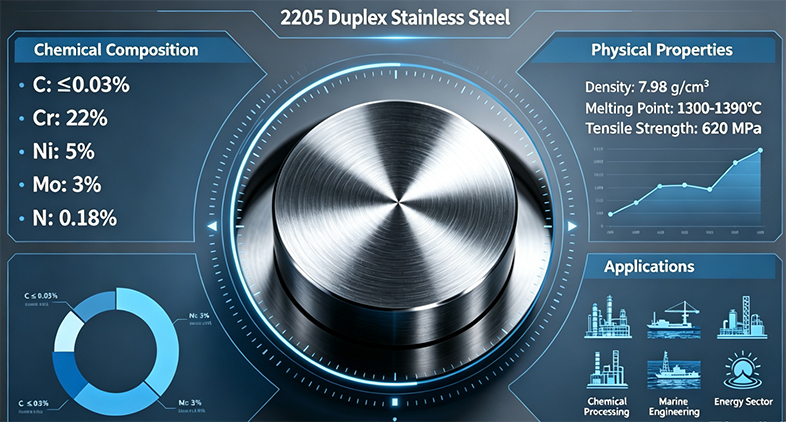
Chemical Composition & Physical Properties of 2205 Duplex Stainless Steel
Grade: UNS S32205 / EN 1.4462 / GB 022Cr22Ni5Mo3N
- Chemical Composition (Weight %, ASTM A240 Standard)
Carbon (C): ≤ 0.03
Silicon (Si): ≤ 1.00
Manganese (Mn): ≤ 2.00
Phosphorus (P): ≤ 0.030
Sulfur (S): ≤ 0.020
Chromium (Cr): 22.0 – 23.0
Nickel (Ni): 4.5 – 6.5
Molybdenum (Mo): 3.0 – 3.5
Nitrogen (N): 0.14 – 0.20
Pitting Resistance Equivalent Number (PREN): 35 – 39
- Physical Properties (Typical values at room temperature ~ 100℃)
Density: 7.98 g/cm³
Melting Point: 1300 – 1390 ℃
Modulus of Elasticity: 190 – 200 GPa
Thermal Conductivity (100℃): 13.7 W/(m·℃)
Linear Thermal Expansion Coefficient (20–100℃): 13.7×10⁻⁶ /℃
Specific Heat Capacity: Approximately 460 J/(kg·℃)
Electrical Resistivity: Approximately 0.8 μΩ·m
Magnetism: Magnetic (typical feature of duplex stainless steel)
- Room Temperature Mechanical Properties (Solution Annealed State)
Yield Strength (Rp0.2): ≥ 450 MPa (Typical: 480 – 550 MPa)
Tensile Strength (Rm): ≥ 620 MPa (Typical: 750 – 850 MPa)
Elongation (A): ≥ 25%
Hardness: ≤ 290 HB (Typical: 250 – 280 HB)