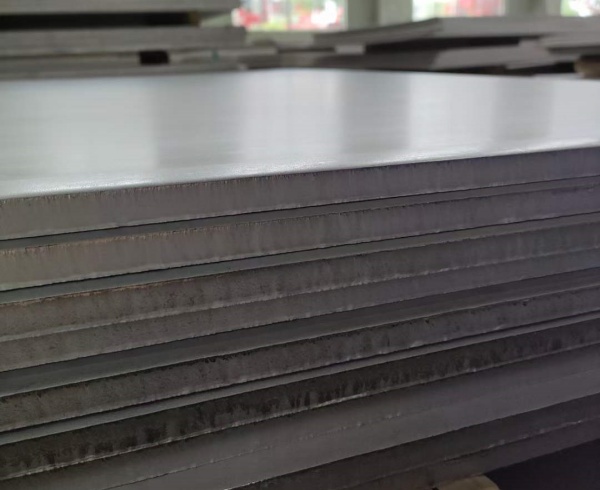
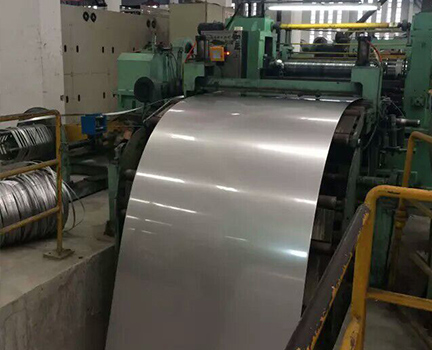
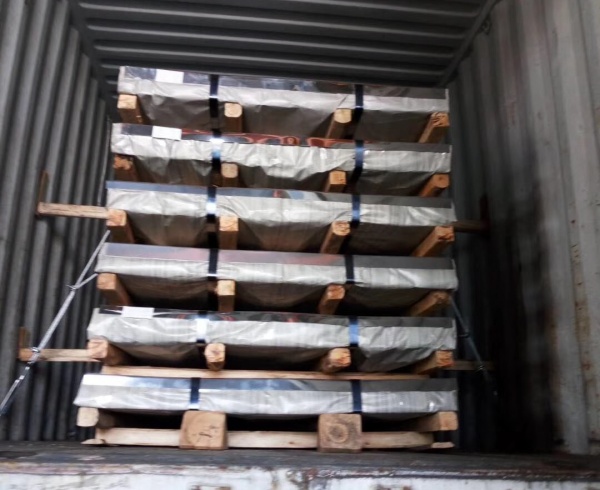
321 stainless steel plate is a titanium-stabilized austenitic stainless steel developed to solve intergranular corrosion caused by welding or long-term high-temperature exposure. Based on classic 18Cr-8Ni composition, titanium (Ti) is added to combine carbon into stable titanium carbide, which restrains chromium carbide precipitation at grain boundaries.
It retains all advantages of 304 stainless steel, plus outstanding anti-sensitization performance and excellent high-temperature creep resistance. Manufactured by hot rolling, cold rolling, solution annealing, pickling and surface finishing, it includes thin cold rolled sheets and thick hot rolled plates with flat surface, uniform thickness and stable metallurgical structure. Widely used for high-temperature pipelines, furnace equipment, boiler parts, exhaust systems and frequently welded high-temperature components that cannot adopt post-weld solution heat treatment.
2. Global Equivalent Grade Cross Reference
| Standard System | Grade Designation | Applicable Standard Code |
| USA (UNS/AISI/ASTM) | UNS S32100 / AISI 321 | ASTM A240, ASTM A480 |
| Japan JIS | SUS321 | JIS G4305, JIS G4306 |
| European EN | X6CrNiTi18-10 / 1.4541 | EN 10088-2 |
| China GB | New:06Cr18Ni11Ti / Old:0Cr18Ni10Ti | GB/T 3280, GB/T 4237 |
| British BS | 321S31 | BS EN 10088 |
| French NF | Z6CNT18-10 | NF A35-571 |
| Swedish SS | SS2338 | SS 2338 |
| Russian GOST | 08Х18Н10Т | GOST 5632 |
Remark: All equivalent grades contain stabilizing titanium element; slight differences in Ti tolerance do not affect high-temperature anti-corrosion performance.
3. Chemical Composition (wt%, Standard Specification Range)
| Element | C | Si | Mn | P | S | Cr | Ni | Ti | N | Fe |
| Limit | ≤0.08 | ≤1.00 | ≤2.00 | ≤0.045 | ≤0.030 | 17.00–19.00 | 9.00–12.00 | ≥5×C Min, ≤0.70 Max | ≤0.10 | Balance |
Core Composition Advantages
Titanium stabilization (Ti ≥5×C): Ti preferentially binds carbon to form TiC, prevents Cr₂₃C₆ precipitation at grain boundaries, completely eliminates intergranular corrosion after welding or long-term holding at 425–815℃ sensitization zone.
4. Physical & Mechanical Properties
4.1 Basic Physical Properties (Room Temperature, Solution Annealed State)
Density: 7.93 g/cm³
Melting range: 1398 ~ 1454 ℃
Thermal conductivity: 15.8 W/m·K
Specific heat capacity: 500 J/kg·K
Resistivity: 0.74 Ω·mm²/m
Linear expansion coefficient (20–200℃): 16.7 ×10⁻⁶ /℃
Elastic Modulus E: 193 GPa
Shear Modulus G: 72 GPa
Poisson’s Ratio: 0.24
Magnetism: Fully non-magnetic after solution annealing; slight weak magnetism after cold rolling, bending or stamping
4.2 Room-Temperature Mechanical Properties (Annealed Base Plate)
| Performance Index | Standard Minimum Value |
| Tensile Strength | ≥515 MPa |
| 0.2% Offset Yield Strength | ≥205 MPa |
| Elongation (50mm gauge length) | ≥40% |
| Reduction of Area | ≥55% |
| Max Brinell Hardness HB | ≤201 HB |
4.3 High-Temperature Core Performance
Long-term continuous service temperature: Up to 850℃, far better anti-sensitization than standard 304.
Excellent creep rupture strength under sustained high-temperature load, resistant to thermal fatigue and cyclic heating deformation.
No intergranular corrosion risk even after repeated multi-pass welding without post-weld solution annealing.
5. Standard Sizes & Thickness Classification
5.1 Thickness Category
Cold Rolled 321 Sheet (CR): 0.3mm ~ 3.0mm
Hot Rolled 321 Plate (HR): 3.0mm ~ 100mm
5.2 Standard Fixed Width & Length (Universal Export Sizes)
Standard Widths:1000mm, 1219mm (4ft), 1500mm, 1524mm (5ft)
Standard Fixed Lengths:2000mm, 2438mm (8ft), 3000mm, 6000mm
Most Popular Finished Sheet Sizes:1000×2000mm/ 1219×2438mm (4×8ft) /1500×3000mm Custom slitting, blanking and special size cutting available on demand.
5.3 Thickness Tolerance
Cold rolled thin sheet: ±0.02 ~ ±0.05mm
Hot rolled thick plate: ±0.3 ~ ±1.0mm
6. Standard Surface Finishes
●No.1 Hot Rolled Pickled SurfaceHot rolling + acid descaling, uniform gray matte surface, thick plate exclusive finish, for boiler, furnace, chemical pressure vessel structural plates without high appearance requirements.
●2B Cold Rolled Annealed & Pickled Surface (Mainstream Grade)Smooth silver matte surface, excellent formability, easy polishing, welding and secondary processing; widely used for exhaust equipment, heat exchanger thin sheets.
●BA Bright Annealed SurfaceClosed bright furnace annealing, semi-mirror clean surface without oxidation film, for precision high-temperature equipment shells and decorative high-temperature components.
●No.4 Brushed Hairline SurfaceFine continuous linear grain, fingerprint-resistant optional coating, used for high-temperature decorative panels and oven visible panels.
●8K Mirror Polished SurfaceHigh-gloss mirror finish, low surface roughness, applied to high-end thermal equipment reflective shielding panels.
7. Common Edge Types
●Slit EdgeClean smooth straight edge with tiny minimal burr, for cold rolled coils and thin sheets, suitable for direct bending and stamping.
●Sheared EdgeFlat straight cut edge, slight burr on bottom cutting surface, mainly for hot rolled thick plates and large-format sheets.
●Laser Cut EdgeBurr-free ultra-precise smooth edge, for special-shaped high-temperature component blanks.
●Deburred Ground EdgeAll burrs removed by grinding, safe contact surface for food and high-temperature hand-operated equipment.
●Chamfered / Rounded EdgeEdge rounded or 45° chamfered, prevent scratch damage to sealing gaskets and operators.
8. Core Key Features
Titanium Stabilized Anti-Intergranular Corrosion (Core Advantage) No chromium carbide precipitation during welding or long high-temperature holding; no need for post-weld solution annealing, irreplaceable for frequently welded high-temperature parts.
Superior High-Temperature Oxidation & Creep Resistance Stable mechanical performance under long-term load at 600–850℃, better thermal fatigue resistance than 304.
Balanced Formability & Weldability High ductility supports deep drawing, bending, stamping; compatible with TIG, MIG, laser and arc welding.
General Atmospheric & Fresh Water Corrosion Resistance Same 18-8 base as 304, good rust-proof performance in indoor, outdoor and fresh water environments.
Wide Temperature Adaptability Maintains good toughness from -196℃ cryogenic to 850℃ continuous high temperature.
Stable Non-Magnetic Performance in Annealed State Suitable for high-temperature precision electrical equipment components requiring non-magnetism.
Long Service Life for Welded High-Temperature Equipment Avoids early leakage and failure caused by weld grain boundary corrosion, greatly extending equipment service cycle.
9. Typical Applications
9.1 High-Temperature Power & Boiler Industry
Boiler inner lining plates, high-temperature flue duct plates, thermal power plant exhaust components, superheater shielding plates, waste heat recovery furnace structural sheets.
9.2 Petrochemical & Refinery Equipment
High-temperature heat exchanger plates, cracking furnace lining sheets, oil refinery high-temperature pipeline cladding, chemical reaction furnace inner plates.
9.3 Automotive & Aerospace Exhaust Systems
Automotive engine exhaust manifold shielding plates, vehicle exhaust muffler inner sheets, aircraft engine auxiliary high-temperature thin plates, aerospace thermal insulation protective sheets.
9.4 Industrial Furnace & Heat Treatment Equipment
Annealing furnace inner lining, oven high-temperature partition plates, heat treatment fixture base plates, muffle furnace sealing sheets.
9.5 Environmental Waste Incineration Equipment
Incinerator high-temperature flue plates, waste gas desulfurization high-temperature structural sheets, biomass boiler inner anti-oxidation lining.
9.6 General Mechanical & Welded Pressure Vessels
High-temperature storage tank lining, welded heat exchange equipment shells, frequently welded anti-corrosion structural plates unable to conduct post-weld heat treatment.
9.7 Food & High-Temperature Kitchen Equipment
High-temperature baking oven inner plates, high-temperature sterilization equipment shells, food thermal processing machinery lining sheets.
10. Grade Comparison Chart
| Grade | Stabilizing Element | Max Continuous Temp | Anti-Intergranular Corrosion | Core Application Scenarios |
| 321 (1.4541) | Ti stabilized | 850℃ | Excellent (no post-weld annealing needed) | Welded high-temperature furnace, exhaust, boiler |
| 304 (1.4301) | No stabilizer | 600℃ | Poor after sensitization | Normal temperature indoor & outdoor structures |
| 304L (1.4307) | Low carbon only | 600℃ | Good, limited working temperature | Medium-temperature welded vessels below 600℃ |
| 310S (1.4845) | High Cr-Ni, no Ti | 1050℃ | Good, high cost | Ultra-high temperature kilns above 900℃ |
11. Executive Standards & Export Supporting Certificates
Compliant with ASTM A240, ASTM A480, EN 10088-2, JIS G4305 / JIS G4306, GB/T 3280, GB/T 4237. Available export documents: MTC material test certificate, SGS third-party composition inspection report, high-temperature performance test report, salt spray test report, fully meet global high-temperature equipment export standards.